Under Construction

We're building something extraordinary for you. Our digital space is currently under refinement. Stay tuned for the unveiling.

Web Alchemy in Progress
footer-logo
Home
PricingAbout UsContact Us
Log inSign Up

28: REPLACE MECHANICAL SYSTEM (MECHANICS SUBSTITUTION)

Replace Mechanical System (Mechanics Substitution) is the practice of achieving a function without relying on slow, heavy, or complex moving parts—by substituting sensory methods (optical, sound, smell), and using fields (electrical, magnetic, electromagnetic, inclusive) or physical backing with gases, liquids, and thermal contact, you shift to 'non-contact' sensing and action that runs cleaner, faster, and more reliably.

This principle is expressed in three common moves:

•

Replace a mechanical system with a non-contact responsive system (optical, sound, thermal, olfactory, electronic or air sensing);

•

Use fields to interact with the object (electric, magnetic, electromagnetic) instead of manual substitution/direct connection;

•

Shift from 'hardware contact' to 'signal/field interaction,' substituting mechanical gears with signal modulation, active air flow, or electronic self-contained control;
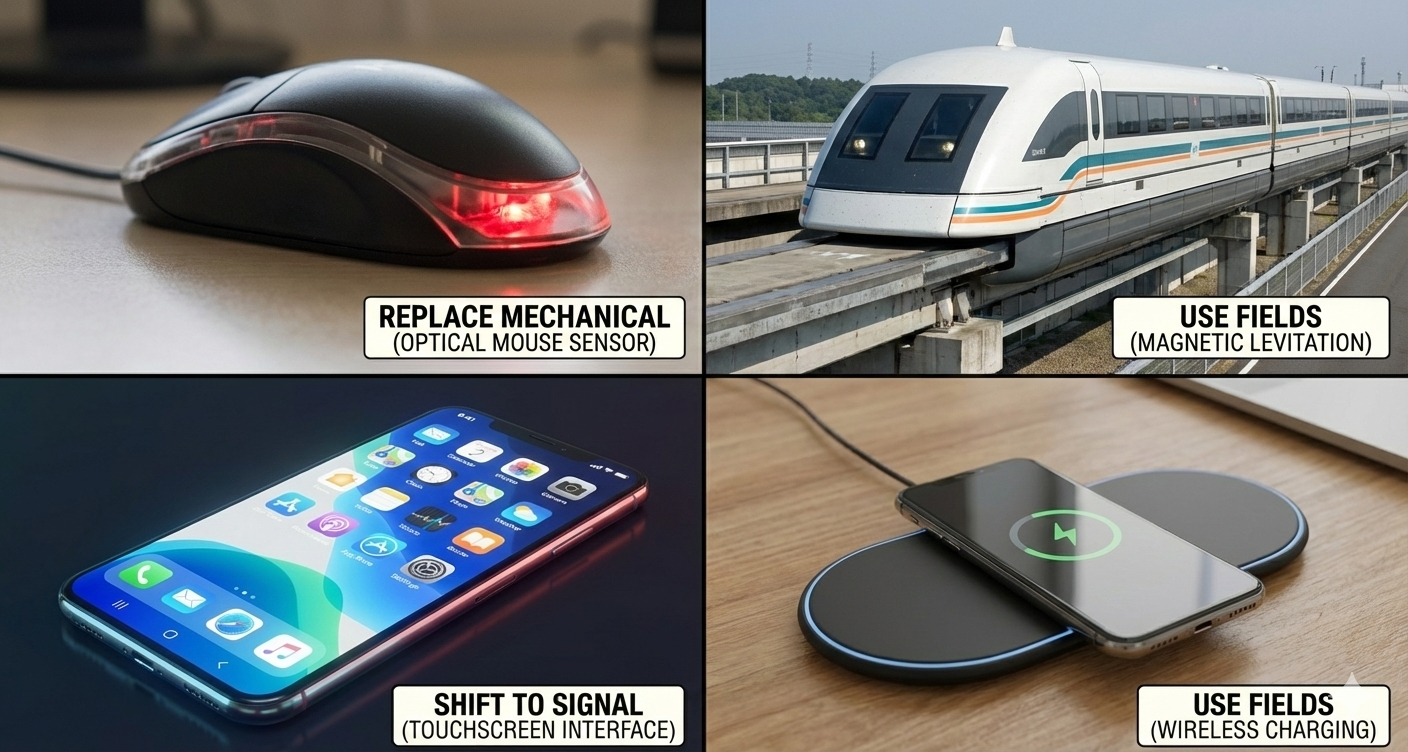
Level sensor illustrating magnetic field substitution for mechanical float
Optical mouse illustrating replacement of mechanical ball
Induction coil illustrating field-based heating
Ultrasonic sensor illustrating sound-based measurement

Why "Replace Mechanical System" creates innovation?

When you substitute mechanics with sensors/fields deliberately, you unlock multiple advantages at once:

1.
Less wear and lower failure points: fewer moving gears, joints, and friction interfaces mean higher reliability and longer life.
2.
Cleaner and safer operation: non-contact sensing eliminates contamination between process and parts or hazardous contact with people and parts.
3.
Higher precision and controllability: signals and fields are easier to modulate, tune, and automate than purely mechanical movements.
4.
Simpler integration and scalability: sensor-driven and field-based modules can be easily updated, replicated, and networked more easily than complex mechanical linkages.
5.
Enables new solution spaces: since you remove mechanical constraints, you can work in new environments (e.g., micro-scale, sensing, field-based activation, high-speed robots).
footer-logo

Our plans are designed to fit innovators at every stage—whether you're just exploring AI-assisted TRIZ tool

Features

  • Resource
  • My Project
  • Pricing
  • About Us

Contact Us

123 214 125
shishimaru@gmail.com

© Copyright by . All rights reserved.