Under Construction

We're building something extraordinary for you. Our digital space is currently under refinement. Stay tuned for the unveiling.

Web Alchemy in Progress

24: INTERMEDIARY

Intermediary is the practice of inserting an intermediate element, layer, or process step between two parts that interact poorly—so you can transfer energy, motion, material, or information more safely and effectively. Instead of forcing direct contact (which may cause friction, damage, contamination, mismatch, or complexity), you use a 'middle agent,' such as an adapter, carrier, buffer, interface, coupling, or service that makes the interaction easier and more reliable.

This principle is expressed in three common moves:

Introduce an intermediary object or process to transfer or mediate the action between components;

Use a temporary intermediary (carrier, fixture, jig, buffer, transport medium) and then remove it after the function is achieved;
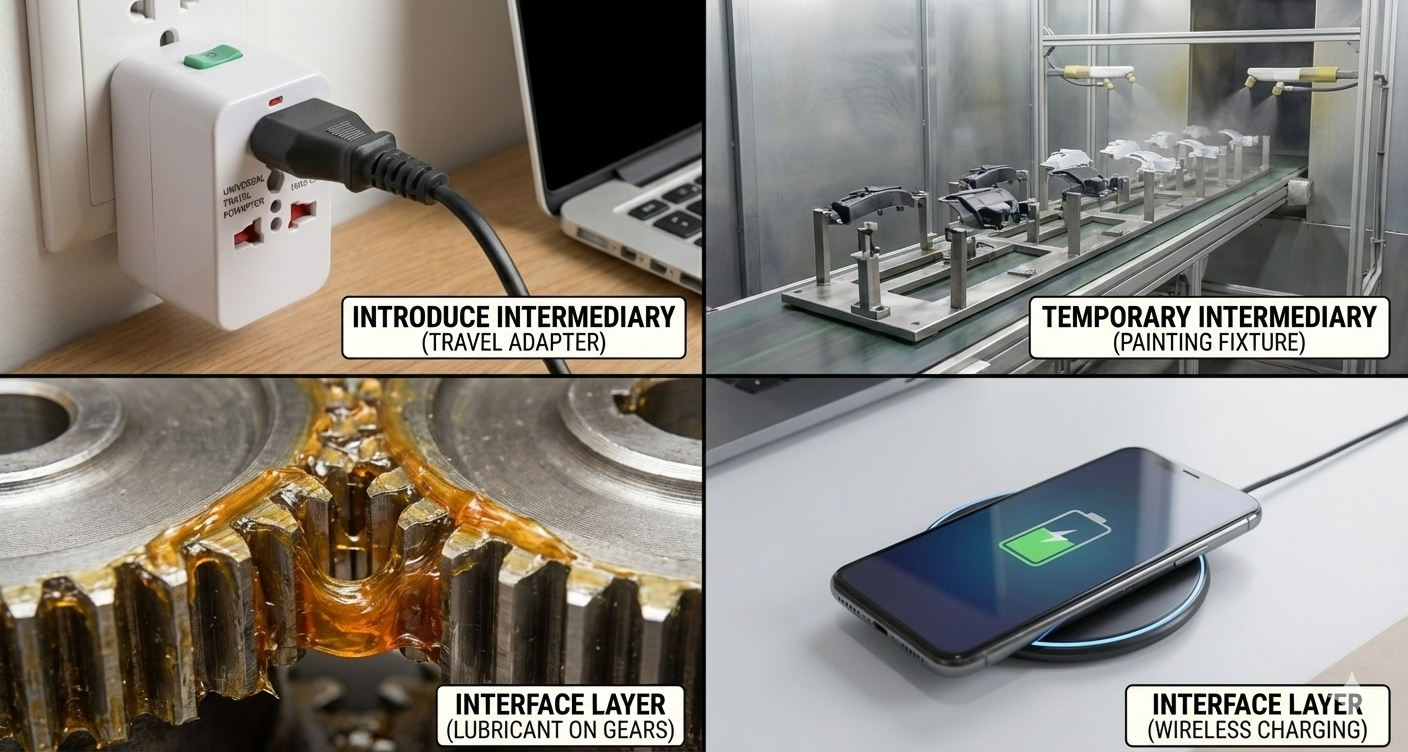
Electrical adapter illustrating intermediary for compatibility

Why "Intermediary" creates innovation?

When you add a smart "middle layer," you unlock multiple advantages at once:

1.
Better compatibility: the intermediary absorbs mismatch (size, material, stiffness, temperature, voltage, protocol) so parts can work together.
2.
Reduced damage and wear: intermediary layers reduce friction, shock, and stress concentration in direct contact.
3.
Cleaner and safer transfer: barriers or carriers prevent contamination, leakage, or exposure while still delivering the useful effect.
4.
Faster assembly and changeover: adapters and standardized interfaces reduce alignment effort and simplify modular replacement.
5.
Enables new architectures: once interaction is mediated, you can separate components physically or functionally (remote actuation, flexible routing, decoupled design).