Under Construction

We're building something extraordinary for you. Our digital space is currently under refinement. Stay tuned for the unveiling.

Web Alchemy in Progress
footer-logo
Home
PricingAbout UsContact Us
Log inSign Up

15: DYNAMICS

Dynamics is the practice of making a system or its parts adjustable, flexible, or adaptable so it can change its behavior or state for each operating condition—instead of having a rigid fixed geometry, design the system to optimally conform at various stages of its lifecycle, configuration, position, softness, shape or strength in multiple behavior states across changing loads, environments, and user needs.

This principle is expressed in three common moves:

•

Change characteristics of an object to change for each stage of operation for best performance (shape, size, stiffness, temperature, speed, settings);

•

Make parts movable or adjustable: hinges, joints, telescoping elements, flexible geometry, moisture dependency;

•

Replace a system or component that is fixed or rigid with one that is dynamically turning, reducing, or pivoting to changing conditions (like pivoting, flexible, or articulated systems);
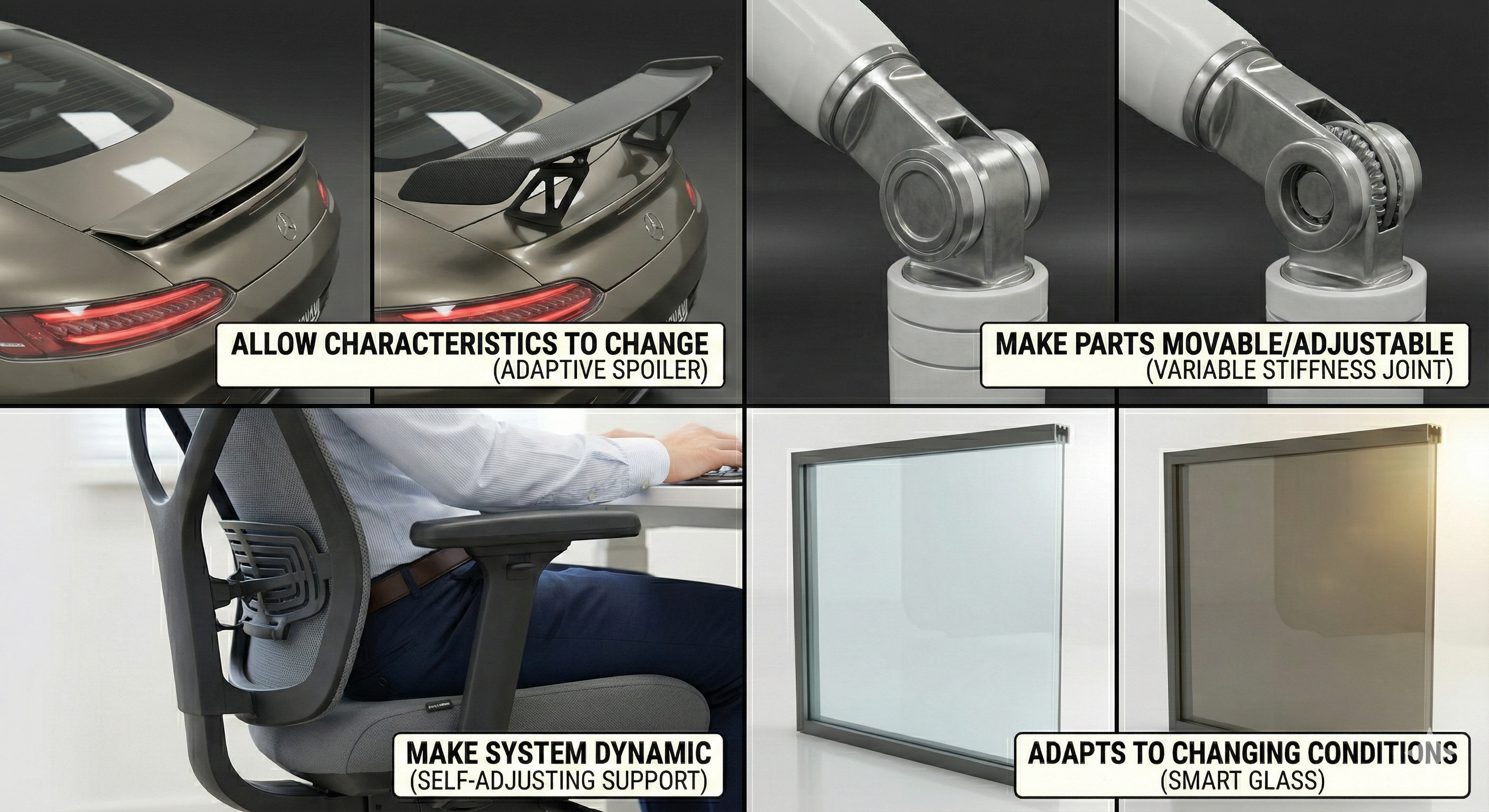
Office chair with multiple adjustments illustrating dynamic fit
Robotic arm with pivoting joints illustrating dynamic movement
Variable sweep aircraft wing illustrating dynamic geometry
Flexible shaft coupling illustrating dynamic tolerance

Why "Dynamics" creates innovation?

When you make a system adjustable on purpose, you unlock multiple advantages at once:

1.
Higher performance across conditions: the system can reach 'best fit' in more than one mode (dynamic versatility), far higher than a fixed system.
2.
Reduced structural stress/load: flexibility and pliability avoid catastrophic failure by letting the system bend rather than break when over-loaded.
3.
Better user experience: adjustability lets different users, tasks, and environments get the right fit without redesign.
4.
Lower complexity vs capability: users don't need to build everything for the worst-case scenario—less weight, cost, and energy.
5.
Improved safety and stability: anti-vibration/damping can adapt to prevent resonance and maintain stability across speed ranges.
footer-logo

Our plans are designed to fit innovators at every stage—whether you're just exploring AI-assisted TRIZ tool

Features

  • Resource
  • My Project
  • Pricing
  • About Us

Contact Us

123 214 125
shishimaru@gmail.com

© Copyright by . All rights reserved.