04: ASYMMETRY
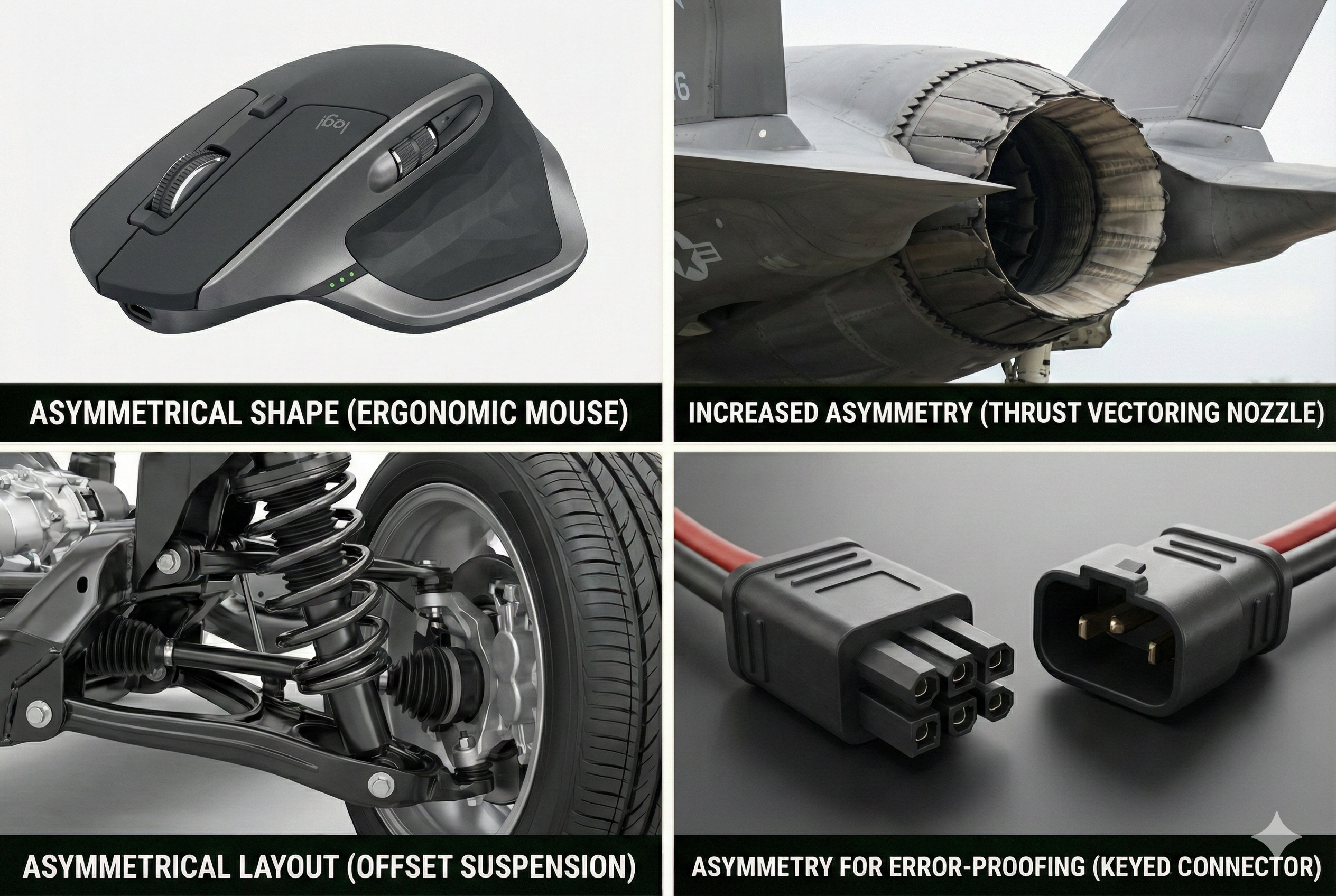
Asymmetry is the practice of moving from a 'perfectly balanced' (symmetrical) design to an unbalanced, non-symmetrical design so the object better handles external forces, direction of motion, flow paths, humans, or space constraints. Symmetrical systems are often 'wasteful' because they treat all directions as the same, whereas asymmetry aligns performance with the actual directional use.
This principle is expressed in three common moves:
Change the shape of an object or structure from symmetrical to asymmetrical;
If an object is already asymmetrical, increase its degree of asymmetry to solve performance or space constraints
Inject directional behavior into a system (flow, force, access) so performance aligns with the dominant use
Why "Asymmetry" creates innovation?
When you introduce asymmetry deliberately, you unlock multiple advantages at once: